
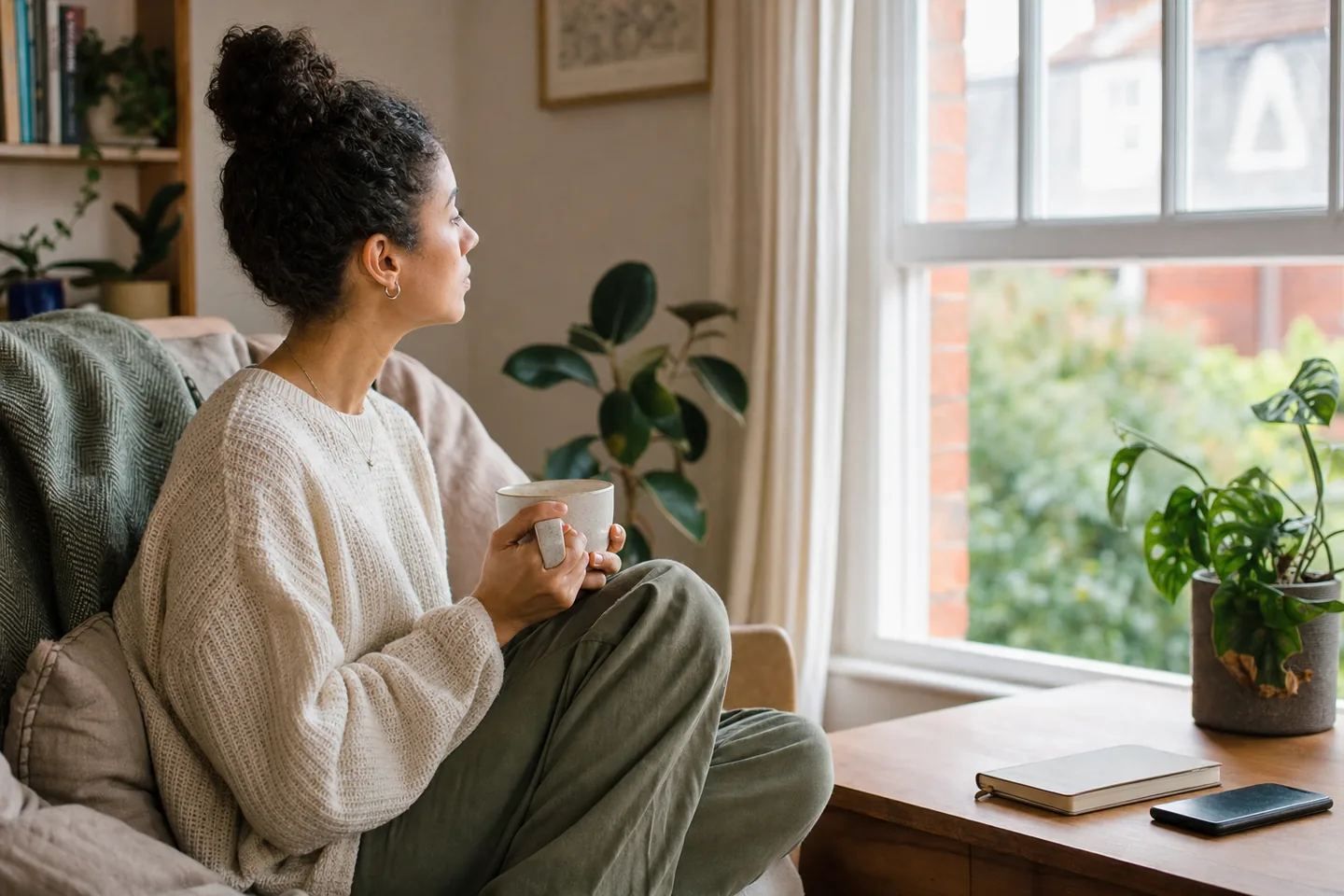
You get home after seeing friends, spending time with family or meeting new people. The conversation seemed fine while it was happening, but now your mind is picking it apart. You wonder whether you talked too much, seemed quiet, said something awkward or gave somebody the wrong impression.
Feeling anxious after socialising can be confusing, especially if you enjoyed yourself. It does not mean that anything went badly or that you have social anxiety disorder. Sometimes a busy mind and body finally have enough quiet to process the day.
This article explains why that uneasy feeling can appear, what may help you settle, and how to make the period after socialising a little kinder.
The short answer
Anxiety can appear when your nervous system is still activated, you are tired, or your attention turns inwards and reviews what you said and did. Uncertainty may encourage harsh assumptions.
The feeling is real, but it is not proof that you embarrassed yourself. A short transition routine, basic care and a balanced response to worried thoughts can help it pass without hours of analysis.
Why can anxiety appear after socialising?
There is rarely one explanation. Your response may vary with the people, setting, energy required and how comfortable you felt.
Your body may still be in social mode
Social situations ask the brain to take in faces, voices, pauses, changes in tone and decisions about when to speak. Noise, light and movement can add to that load. Once you leave, tiredness, tension or a fast heartbeat may become more noticeable. That unsettledness can feel like evidence that something is wrong, even when your body is simply coming down from a demanding environment.
Your attention may turn inwards
After a conversation, the mind sometimes switches from taking part to reviewing your performance. You may replay your words, picture how you looked or search your memory for signs that someone was bored, annoyed or unimpressed.
NICE guidance on social anxiety recognises self-focused attention and post-event processing as patterns clinicians may explore during an assessment. This does not mean everyone who replays a conversation has a condition. It helps explain why reviewing feels convincing: the mind is examining the event through the narrow lens of possible mistakes.
Uncertainty leaves space for anxious guesses
Most social interactions do not come with a clear verdict. An anxious mind may try to create certainty by assuming the worst: "They thought I was boring" or "I should not have said that". These thoughts can feel like conclusions, but they are interpretations made without all the information.
You may be depleted
Hunger, dehydration, poor sleep, alcohol and caffeine can affect how steady you feel. So can masking discomfort or monitoring yourself closely. When your resources are low, it is harder to respond thoughtfully; the same conversation may look less alarming after food, water and sleep.
The situation may have touched an older fear
Some occasions carry extra meaning. Meeting a partner's friends, returning after time away or starting a new job can raise fears about belonging or rejection. Your reaction may reflect how important acceptance feels in that setting.
What may help right now
The aim is to give your body and mind enough steadiness that every anxious thought does not feel urgent.
1. Create a short transition out of the event
Give yourself ten quiet minutes before opening messages or reviewing the evening. Change into comfortable clothes, wash your face, make a warm drink or sit somewhere with softer light.
This gives your body a clear signal that the social demand has ended.
2. Check what your body needs
Ask a few plain questions before analysing the conversation:
- Have I eaten enough?
- Have I had some water?
- Am I overtired or overstimulated?
- Have I had alcohol or more caffeine than usual?
- Would a shower, a quiet room or a few minutes of gentle movement help?
Meeting a physical need will not solve every worry, but it can lower its volume.
3. Slow your breathing without forcing it
If breathing exercises suit you, let your breath become comfortable and unhurried. You might breathe in gently and allow the out-breath to last a little longer. The NHS offers a simple breathing exercise for stress that can be done almost anywhere.
If focusing on breathing makes you more anxious, use an external anchor instead. Notice the support of the chair, name five ordinary things you can see, or listen carefully to one familiar piece of music.
4. Separate what you know from what anxiety is adding
Take one worried thought and divide it into two columns:
What I know: "The conversation became quiet for a moment."
What anxiety is adding: "Everyone thought I was boring."
You do not need to replace the anxious thought with an unrealistically positive one. A balanced response is enough: "I cannot know what everyone thought. Pauses happen in normal conversations."
5. Put a boundary around the review
Rather than trying to ban the thought, decide that you will not conduct a full investigation tonight. Write the concern in one sentence, then add: "I can look at this tomorrow if it still seems important." Many worries lose urgency after rest.
For more support with thoughts that keep circling, the free guide to stopping overthinking offers practical ways to create some mental distance.
6. Use one compassionate closing sentence
End the evening with language that is believable rather than grand. For example:
- "I was allowed to be an ordinary person in that conversation."
- "One awkward moment would not define the whole evening."
- "I do not have to earn rest by proving that everybody liked me."
- "I can feel uncertain without sending an apology."
Pick one sentence; repeated reassurance can become another form of checking.
What can make the anxiety feel harder?
Some responses bring brief relief but keep the review going.
Replaying the event from beginning to end
Memory is not a recording. Replaying tends to highlight the parts you fear and remove them from context. If reviewing has not produced one useful action, another round is unlikely to provide certainty.
Checking for reassurance
Rereading messages, asking whether you were annoying or sending an apology may settle anxiety briefly, but can teach your mind that uncertainty must always be checked. Ask: "Is there a specific harm to repair, or am I trying to make this feeling disappear?" If there is no clear issue, waiting may be kinder to you.
Treating tired thoughts as reliable evidence
Late-night conclusions are often harsher. Unless something needs immediate attention, avoid making decisions about friendships, work relationships or your own character when you are depleted.
Avoiding the next invitation
Avoidance can make the next occasion feel even more significant. If socialising is draining, adjust the size or length of the plan rather than assuming you must stop altogether.
A gentler plan for next time
A small before-during-after plan can reduce pressure.
Before
- Eat beforehand and decide roughly when you would like to leave.
- Choose a realistic intention, such as having two genuine conversations.
During
- Return your attention to the conversation when you notice self-monitoring.
- Take a short break if the environment becomes too much.
After
- Follow the same transition routine.
- Delay reassurance messages unless there is a clear practical reason to send one.
- Keep the next hour simple: food, water and lower stimulation.
The daily self-care guide can help you build a realistic routine for days when your emotional energy is limited.
When professional support may help
Occasional post-socialising worry is common. It is worth seeking support if fear and reviewing happen regularly, cause significant distress, affect sleep or work, lead you to avoid people and opportunities, or make you rely on alcohol or other substances to cope.
The NHS advises speaking to a GP when social anxiety is having a significant impact on your life. In England, you may also be able to refer yourself to an NHS Talking Therapies service. NICE recommends individual cognitive behavioural therapy designed specifically for social anxiety disorder as an initial treatment for adults who are diagnosed with it.
A professional can help you understand your pattern and check whether physical symptoms or another health concern need attention.
If you feel unable to keep yourself safe or are in immediate danger, call 999 or go to A&E. You can call Samaritans free on 116 123 at any time if you need someone to talk to.
Helpful next steps on Loving Myself
- Use the free anxiety guide for grounding ideas and gentle ways to settle an activated body.
- Use the practical guide to finding a stopping point for conversation replays when one exchange is taking over your attention.
- Explore the daily self-care guide for simple ways to recover after a demanding day.
Frequently asked questions
Does feeling anxious after socialising mean I have social anxiety?
Not necessarily. Many people occasionally feel unsettled, tired or self-conscious after spending time with others. Social anxiety disorder involves a persistent fear of social situations and may lead to significant distress, avoidance or disruption to everyday life. Only a qualified professional can assess and diagnose it.
Why does the anxiety sometimes appear the next day?
Your mind may review the event once other demands quieten down. Poor sleep, alcohol, tiredness or a message from the event can also restart worry. A delayed feeling is not evidence that you missed a hidden problem.
How can I know whether I actually said something wrong?
Look for facts rather than a feeling of embarrassment. Did someone say they were hurt? Can you identify a specific comment that conflicts with your values? If so, a brief repair may be appropriate. If the concern keeps changing or demands repeated reassurance, anxiety may be seeking certainty.
Should I keep socialising if I always feel drained afterwards?
Try changing the conditions: meet one person, choose a quieter place, set an end time or leave recovery space afterwards. If anxiety is steadily shrinking your life, consider speaking to a GP or therapist.
Conclusion
Anxiety after socialising can make an ordinary conversation feel as if it needs a detailed investigation. Usually, the most helpful response is smaller: help your body come out of social mode, meet basic needs, separate facts from anxious guesses and postpone decisions until you are rested.
You do not need to prove that the interaction was perfect before you are allowed to let it go. Start with one quiet transition and one balanced sentence tonight.
You can explore all the free Loving Myself guides for further practical support.
Sources and further reading
- NHS: Social anxiety (social phobia)
- NICE guideline CG159: Social anxiety disorder - recognition, assessment and treatment
- NICE recommendations for social anxiety disorder
- NHS: Get help with anxiety, fear or panic
This article provides general wellbeing information and is not a substitute for individual medical advice, diagnosis or treatment.